
Yanaguana volume 1, issue 2 spring/summer 2026 a literary journal from San Antonio, Texas
sarah joy thompson
reviews
my mother, the butcher
Sarah Joy Thompson
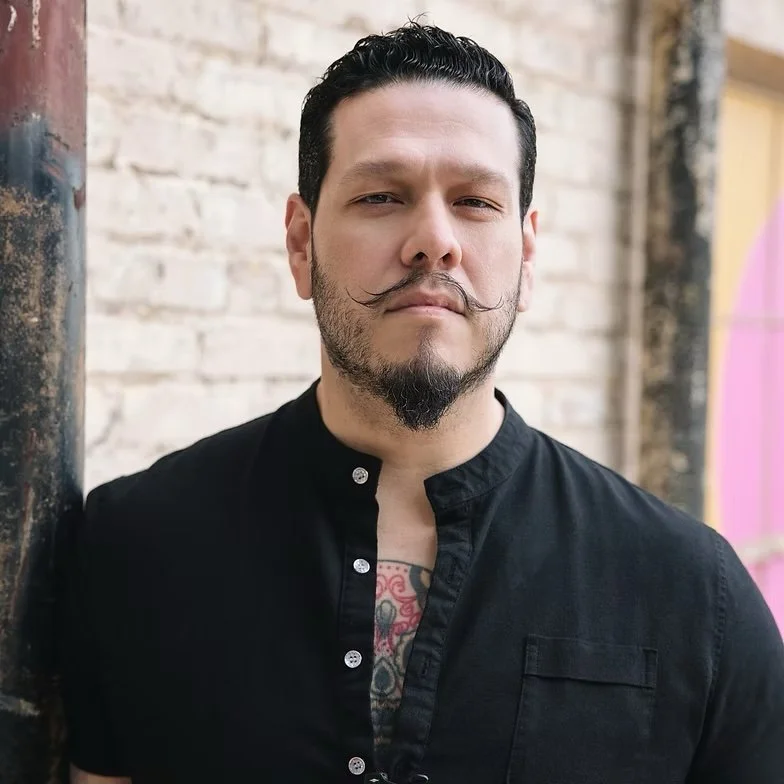
Gerard Robledo
Gerard Robledo’s poetry collection My Mother, the Butcher is a brave soliloquy of both past hurts and desire for resolution. Each precise word, each gripping line break leaps off the page, as in these lines when the speaker’s soul has grown weary from the years of his crushing upbringing:
the painful truth—
my mother’s bloody apron,
the butcher. She wears sections of my childhood
like outlined choice cuts.
Herein an identity shaped by childhood trauma is given permission to breathe, one corito at a time.
In this poetry collection, the speaker weaves between past and present as he unveils the origins of his wounds:
like the flickering neon
of the seedy motel my mother and I stayed in
with one eye open, hiding from her merciless husband.
With each confession, he holds a door open to the past and scrutinizes his own humanity. The devotion to his daughter and the commitment to being present are focal points for the speaker to invite some resemblance of serenity into his life:
It’s what my grandmother taught me while decrying
my mother’s incapability. It’s what I’ll show my brothers
men do with an iron and starch.
Parenthood doesn’t come in one size fits all, but somehow one man overturns decades of emotional flogging by reclaiming his narrative through providing the necessary tenderness to his own daughter:
Now you kick off the blankets I secured
under your delicate elbows, curl yourself
inward—my tangled pill bug.
For a man who has labored through fields of hardship it’s no wonder that keeping order is a delicate balancing act:
She wants me to be everything:
a good father and mother, nurturing like taught,
and masculine like I never saw.
Yet, despite the challenges, there is still a promise to champion his daughter’s growth and happiness:
For her, I’ll pretend I’m a dumb rock of a man
while I caress bruises and bake dinner.
Although the speaker arrives at no definitive resolution in these poems, it does seem that, gradually, he learns the ropes of navigating his own complex emotions, masculinity, and fatherhood. Despite the lingering external and internal tortures of the past, he faces the present moment, finding ritual in packing school lunches for his daughter and meditating on the fact that one day she will
outgrow me, my missteps,
and acknowledge I was always there,
though, with whiskey in hand.
Ultimately, the poems in My Mother, the Butcher remind us that survival is not the end of the story—choosing to do the inner work is a radical act. Perhaps the estranged mother admitting, “I should have just been there,” is a much-anticipated truth, which arrives like the first glass of water imbibed the morning after a restless night. These songs of the self hold a brutal honesty and longing for compassion. They are echoes in the dark, wanting to take your hands and give them a good squeeze.
A Radical Act
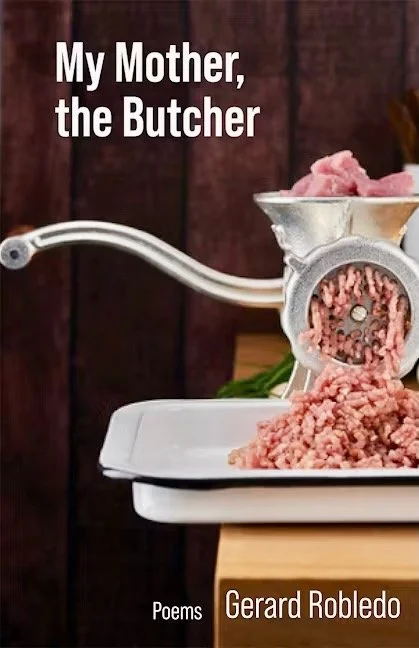
My Mother the Butcher, poems by Gerard Robledo, Texas Review Press, 2025
Sarah Joy Thompson is a Filipina American poet and the author of three poetry collections, including The Everyday, the Mundane, and the Brave (Finishing Line Press, 2019), Driving into Black Mountains (FlowerSong Press, 2020), and Uprooted Orchid (FlowerSong Press, 2025). She earned an MFA in Creative Writing from the University of Texas at El Paso. In her recent work, Sarah Joy explores poetry and movement as pathways to navigate grief, loss, illness, and embodying change. By leaning into the dance of transformation as a healing process, the body can find true rest and mindful self-compassion.
Gerard Robledo is a Mexican American poet from San Antonio and an immigrant son. He holds an MFA in Creative Writing from the University of Texas at El Paso and teaches at Palo Alto College. His Spanish language poetry translations, poetry, and book reviews have appeared in Voices de la Luna, The Texas Observer, Oyster River Pages, Solstice Magazine, Poetrybay, Vox Populi, and others. He is a Macondo Writers’ Workshop Fellow, and a recipient of the 2020 Eduardo Corral Emerging Latinx Writers Mentorship.
jean hackett
reviews
somehow, i haven’t drowned
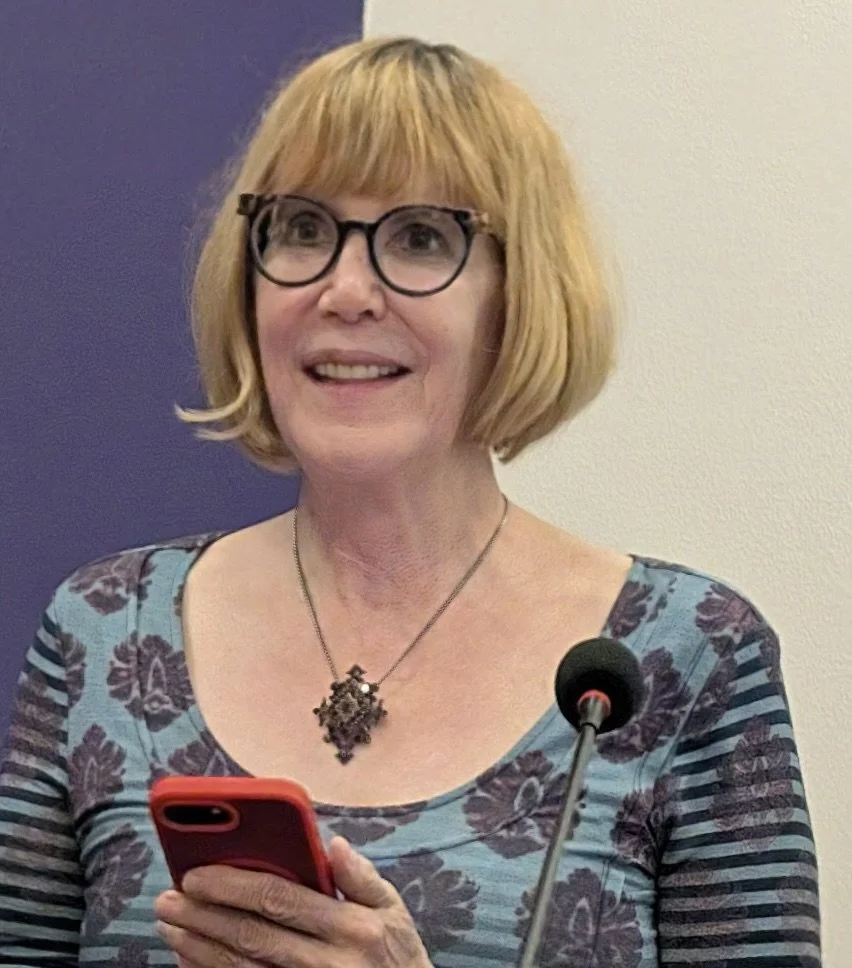
Jean Hackett
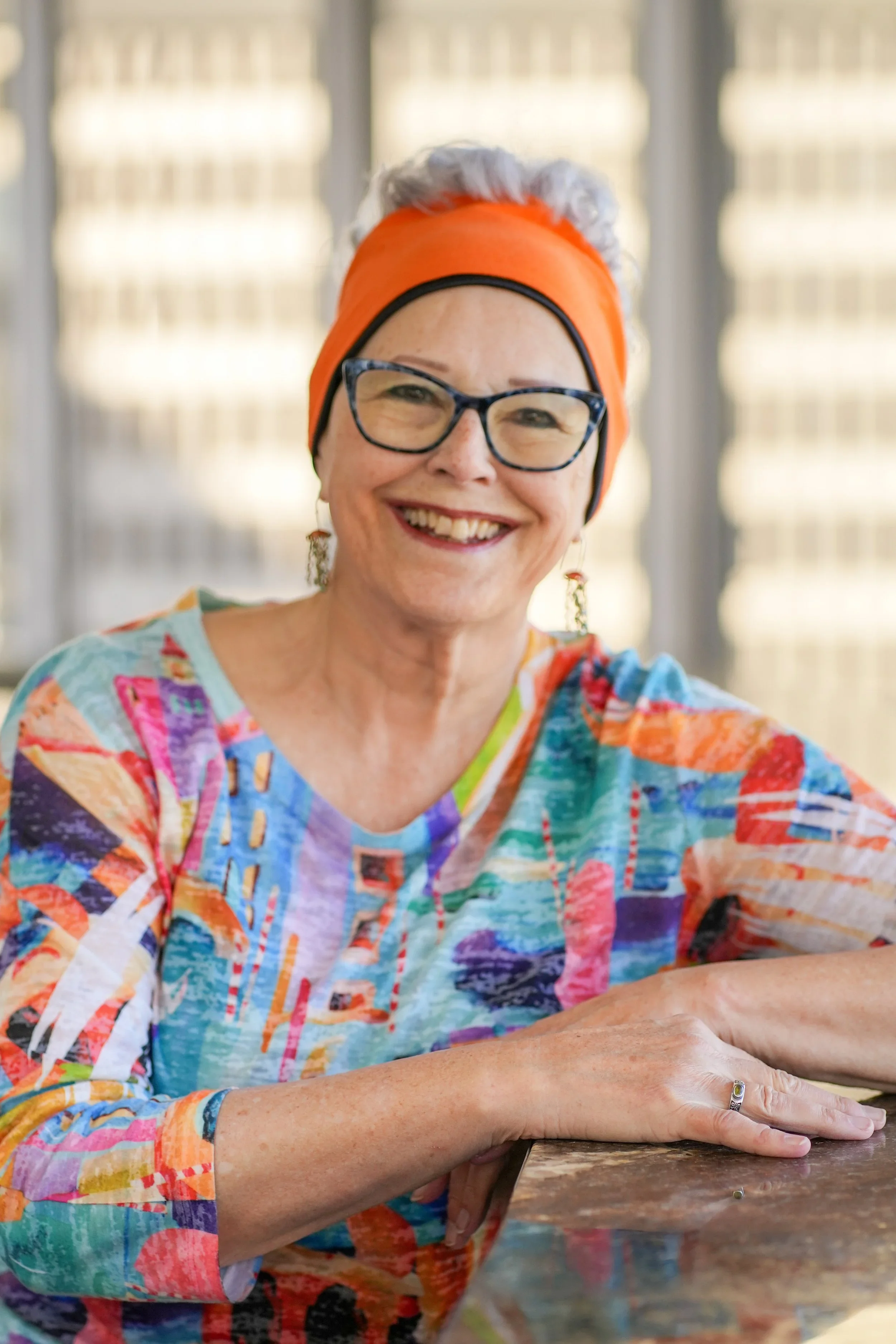
Robin Gabbert
Life Lessons From a Wise Woman
In the first lines of Somehow, I Haven’t Drowned, Robin Gabbert invites us to
slip into that space
between light and dark
find a niche
enter my palace
that is not a palace.
Oh, what a space it is! The poet slyly guides us through a life filled with seascapes and dreamscapes, girlhood treetops and mature romances, and births and deaths. She spins together individual poems recounting joy or terror into a collection built like a kaleidoscope, where ever-changing patterns reflect how the poet has transformed survival into a whimsical, meaningful journey.
Don’t let Gabbert’s gentle, reserved writer’s voice fool you. In Somehow, I Haven’t Drowned she proves a poet can express primal honesty filtered through subtle style. Inspired by former US Poet Laureate Rita Dove, she has compiled a collection which speaks to the everyday lives of women.
“Several years ago, I decided that I wasn’t going to hold back in my writing, even if it was painful,” Gabbert commented. “I want readers to be able to relate to my experiences and not feel so alone.” In doing so, she brings readers along, not only on journeys of trauma and grief, but also through explorations into what brings joy, and how self-reflection opens us to emotional support.
Gabbert hasn’t organized her poems chronologically. Instead, she has divided them into five water-titled sections: “Take the Plunge,” “Whirlpool,” “The Ocean is Deep,” “Letting the Waves Wash Over Me,” and “Treading Water.” Each section combines autobiographical poems from various life stages that fit together like different colored pieces of glass to form a mosaic. This arrangement provides us with insight into how memories of important life events continually reshape us throughout the years.
Most portions of the collection go down easy. Poems that explore difficult subjects are often followed by beautifully descriptive or humorous pieces. The exception is “Whirlpool,” the book’s second section. In the section’s first poem, Gabbert announces that to combat each personal demon she will
write him into a poem, paint him into a mural,
pick up his pieces
and sew them like animal hides
until they make a pleasing form.
Here, she bravely exposes abusive men from her childhood. In addition, she confesses how
No amount of clipping
stripping or cutting
will destroy them.
Yet at night,
I’m back ripping ... exposing ghastly faces
to the light over
and over and over
again.
In “The Ocean Is Deep,” the book’s third section, Gabbert includes several ekphrastic poems, in addition to her autobiographical musings, to illustrate how all art forms and responses to them provide a means to express all emotions. It is through the arts, in this case poetry, that Gabbert has not drowned, despite life’s difficulties.
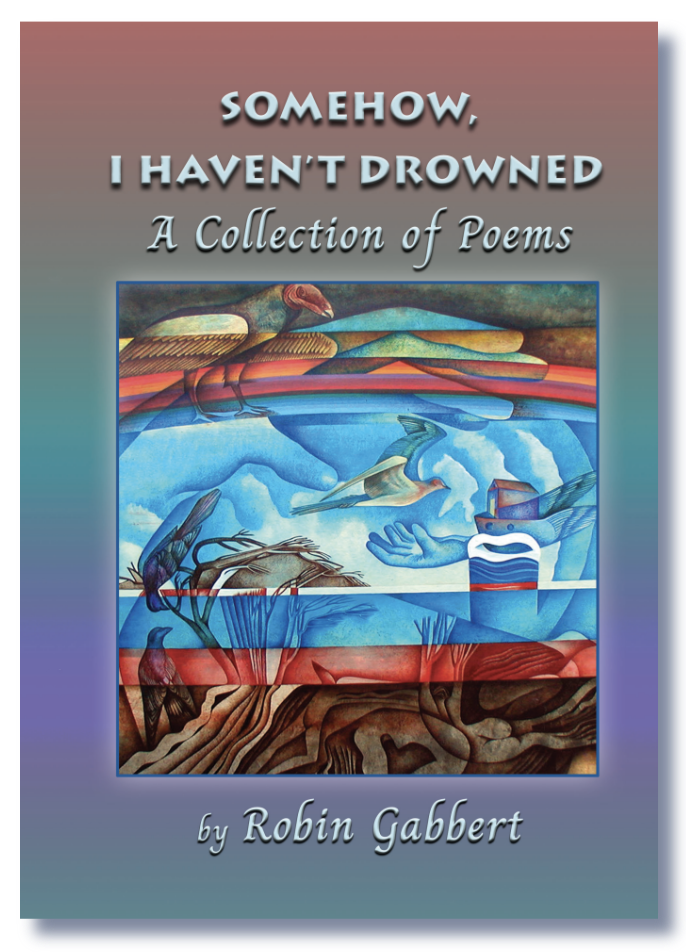
Somehow, I Haven’t Drowned, poems by Robin Gabbert
Blue Light Press, 2025
Jean Hackett is a poet, educator, and naturalist who splits her time between San Antonio, Texas, and her property in the Texas Hill Country. She received her bachelor’s and master’s degrees from the University of Texas at Austin. Her poetry has appeared in Voices de la Luna, Arts Alive San Antonio, Langdon Review, No Season for Silence, Love Is, Words for Birds, Tejascovido, Cocktail Journal, Senior Class, Plants & Poetry Journal, Fourth Nature: An Urban Garden, and The Windward Review. Her first chapbook, Masked/ Unmuted, was published in 2022.
Robin Gabbert has poems in multiple Redwood Writers poetry anthologies, the California Writers Club Literary Review, and in The Best Haiku 2022 International Anthology from HaikuCrush. Several of her haiku, tankas, haibun and other poems appear in two anthologies from Blue Light Press, Burro in My Kitchen (2022) and Poured Out From the Big Dipper (2023). Her chapbook, Diary of a Mad Poet was published in 2020. Her book of ekphrastic poetry, The Clandestine Life of Paintings and Poetry was published in November 2022. Somehow, I Haven’t Drowned, her new collection of poetry, was published in 2025 by Blue Light Press. Robin lives in California wine country with her Dutch husband Con Jager and pup Hamish.